
After several years of economic turbulence, Ghana's macroeconomic recovery has exceeded many expectations.
Inflation has fallen sharply, the cedi has stabilised, foreign exchange reserves have strengthened, economic growth has outperformed expectations, and the International Monetary Fund has upgraded Ghana's risk of debt distress from high to moderate. Following one of the deepest economic crises in the country's history, Ghana has restored an important measure of macroeconomic stability through fiscal consolidation, tighter monetary policy, debt restructuring and renewed investor confidence.
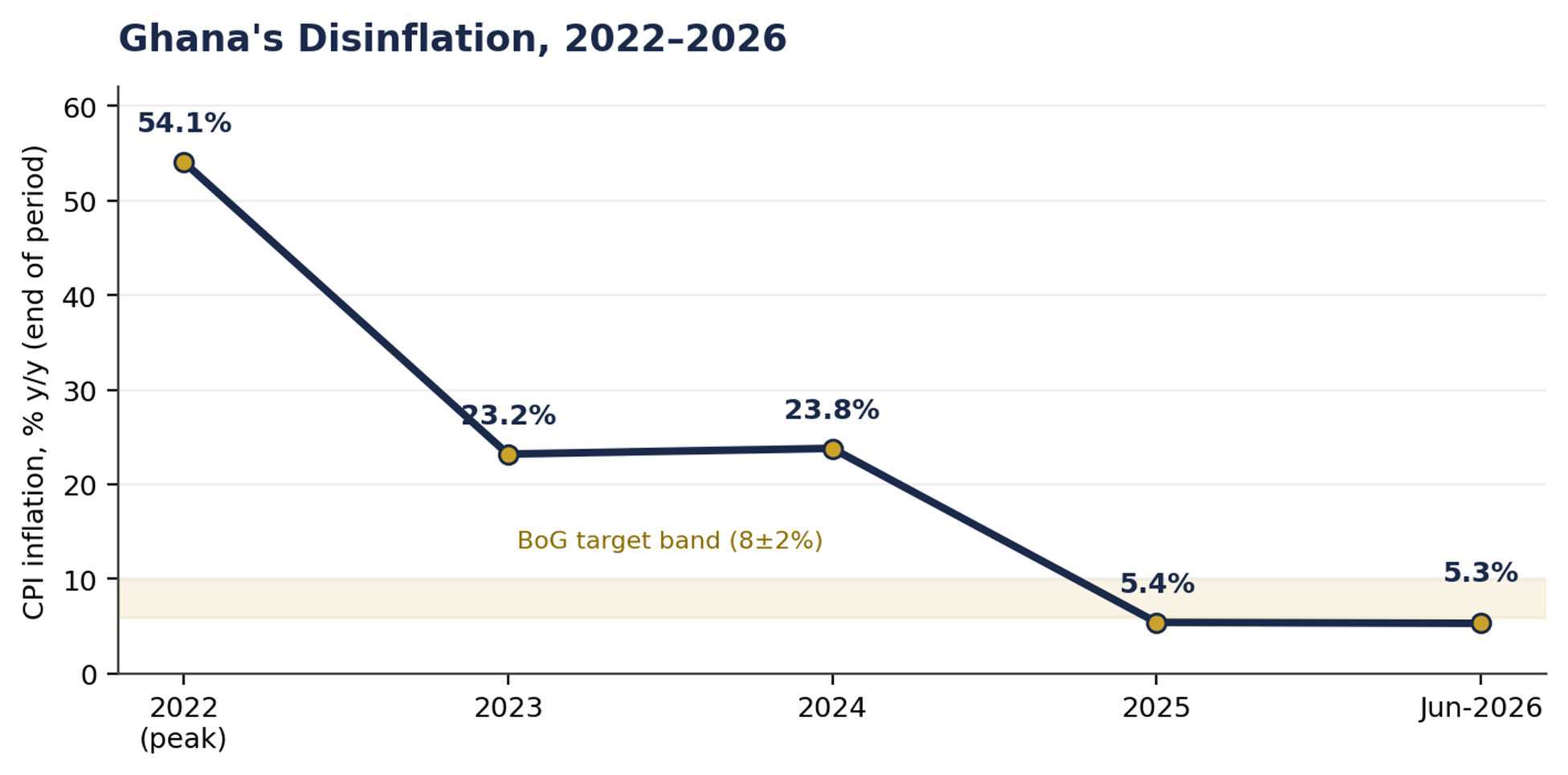
The scale of the turnaround is worth stating plainly: inflation fell from a peak of 54.1% in 2022 to 5.4% by the end of 2025, while gross international reserves rose from 2.4 months of import cover in 2024 to 4.0 months, roughly US$11.9 billion, by the end of 2025.
Stability has created an opportunity. It has not guaranteed the outcome.
These achievements deserve recognition. Yet they should not breed complacency. The country's greatest economic challenge no longer lies in restoring macroeconomic stability; it lies in transforming that stability into sustained, inclusive and private sector-led prosperity.
The ECF has ended, but the hardest work is only beginning. Ghana must now prove that it can preserve stability without relying on IMF financing, convert a commodity-supported recovery into a diversified economy, and produce improvements that citizens can see in their jobs, incomes and living standards.
Stability Is Not the Same as Prosperity
Macroeconomic stabilisation is a necessary condition for development, but it is not sufficient. Lower inflation restores purchasing power. Higher international reserves improve investor confidence. Debt restructuring creates fiscal breathing room.
These are important achievements, but they do not automatically create productive jobs, improve living standards, raise productivity, or transform an economy. Countries become prosperous not simply because inflation is low or public finances are stable. They become prosperous because businesses invest with confidence, workers become more productive, innovation accelerates, institutions function effectively, and capital is allocated efficiently. Macroeconomic stability creates the conditions for growth, but sustained prosperity ultimately depends on productivity, private investment, innovation, and strong institutions.
The IMF itself makes this distinction. While commending Ghana's recent progress, it repeatedly emphasises that important vulnerabilities remain and that continued structural reforms are essential to preserve macroeconomic stability, strengthen debt sustainability, and support long-term growth.
Ultimately, citizens will judge Ghana's recovery not by lower inflation alone, but by whether it delivers better jobs, higher incomes, rising productivity, and broader economic opportunities, particularly for the country's growing youth population. On this measure, the record is far more mixed than the headline indicators suggest: World Bank data cited in the report show $3-a-day poverty easing only from 38.9% in 2022 to 37.1% in 2025 despite the macro turnaround, while youth unemployment among 15- to 24-year-olds has remained stubbornly close to 30%.
Ghanaians will not judge the recovery only by the policy rate, reserve cover or the debt-to-GDP ratio. They will judge it by whether young people can find work, small businesses can obtain affordable credit, household incomes are rising, and public services are improving. A recovery that looks strong in the national accounts but weak in ordinary lives will struggle to retain public support.
Gold Strengthened the Recovery but Also Exposed Its Fragility
One aspect of the IMF report that deserves greater attention is its balanced explanation of Ghana's recovery. The improvement did not occur solely because of better domestic policies. Exceptionally strong gold prices acted as an important external stabiliser. Higher gold export receipts strengthened Ghana's balance of payments, accelerated reserve accumulation, supported exchange-rate stability, and improved the country's debt trajectory. The scale of that dependence is striking: gold accounted for more than 65% of total goods exports in 2025, a share the IMF expects to rise to around 70% in 2026.
Recognising this reality does not diminish the government's achievements. Rather, it highlights an important lesson: favourable global conditions cannot always be relied upon. The IMF cautions that Ghana's improved debt outlook remains vulnerable to external shocks, particularly fluctuations in gold prices and other commodity exports. The Fund's own tail-risk analysis puts a number on that exposure: a modelled 45% correction in gold prices would push the external debt-service-to-revenue ratio through its sustainability threshold by 2030.
The challenge now is to convert today's commodity-driven stability into a more diversified and resilient economy. Sustainable prosperity will require expanding manufacturing, agribusiness, services, technology, and other higher-value industries that broaden the country's export base, attract long-term private investment, and reduce dependence on commodity cycles.
There is a tension worth naming here: the IMF's own external sector assessment finds that the cedi's sharp real appreciation has corrected a prior undervaluation, but warns that continued strengthening risks eroding competitiveness in the non-extractive export sector. This is the classic Dutch disease bind facing gold-dependent economies, where the currency strength that stabilises the macro picture can quietly undercut the diversification agenda meant to reduce reliance on it.
Gold dependence also carries governance and environmental costs. Illegal mining, smuggling, polluted water bodies and the destruction of agricultural land cannot be excluded from the economic calculation. Ghana must ask not only how much gold it exports, but how much value the state retains, how transparently that value is managed and what environmental liabilities are being created for future generations.
The answer is not to turn away from gold. It is to use the current windfall to build the productive sectors that will still be competitive when the commodity cycle changes. Reliable energy, irrigation, transport links, digital infrastructure, industrial skills and predictable regulation would allow agribusiness, manufacturing, technology and tradable services to expand. Commodity wealth becomes development only when it finances capabilities that survive the commodity boom.
The Biggest Threat Is No Longer Inflation
Many government officials naturally associate economic crises with inflation. Only a few years ago, inflation exceeded 50%. Today, however, inflation has fallen below the Bank of Ghana's target range.
The IMF identifies a different source of concern. Throughout its report, it repeatedly highlights fiscal risks arising from state-owned enterprises, particularly in the energy and cocoa sectors, and emphasises that stronger governance and oversight of these institutions are essential to preserving debt sustainability.
- Energy: cost-reflective tariffs, finalising the Private Sector Participation process, and enforcing full cash-waterfall-mechanism compliance so that independent power producers and fuel suppliers are paid on time.
- Cocoa: diligent implementation of Cocobod's new producer pricing rule and its Turnaround Strategy.
This deserves far greater public attention. Ghana has repeatedly reduced fiscal deficits only to see new liabilities emerge through weakly governed public enterprises. Unless these institutional weaknesses are addressed, future governments may once again be forced to absorb losses onto the national balance sheet, reversing hard-won fiscal gains.
Macroeconomic stability therefore depends not only on sound budgets, but also on well-governed public institutions capable of managing fiscal risks before they become sovereign liabilities. Ghana also remains vulnerable to external shocks, including commodity-price fluctuations and tightening global financial conditions, which makes preserving fiscal buffers, maintaining policy credibility, and continuing structural reforms all the more important.
Reform Fatigue Is Now the Greatest Risk
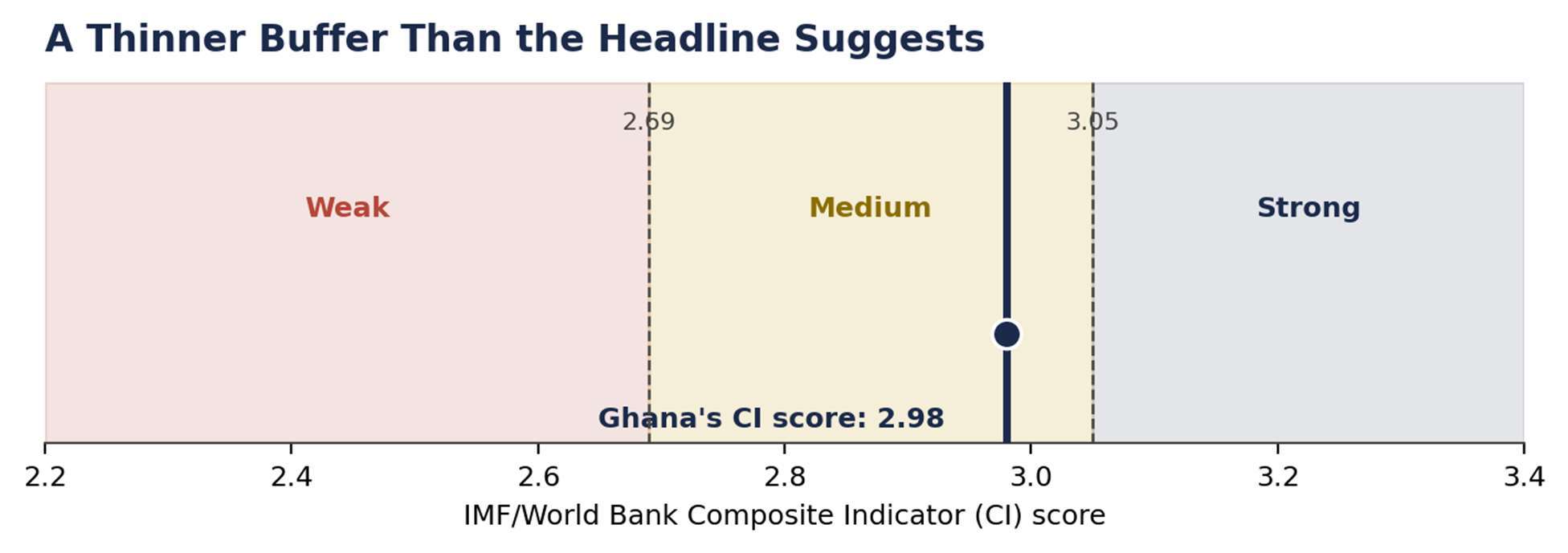
Perhaps the most important warning in the IMF report is that Ghana's policy credibility has improved but remains fragile. The report cautions that reform fatigue and political pressures could undermine the hard-won gains achieved over the past three years. The Fund's own debt-carrying-capacity metric illustrates just how fragile: Ghana's Composite Indicator score of 2.98 sits comfortably inside the medium capacity band, but far closer to the 2.69 weak cut-off than to the 3.05 strong one.
This is a familiar challenge. Economic reforms often receive strong political support during periods of crisis, when the costs of inaction are unmistakable. Sustaining those reforms once economic conditions improve is considerably more difficult.
History shows that countries rarely lose macroeconomic stability overnight. They lose it gradually through small policy reversals, weakening institutions, delayed reforms, and declining fiscal discipline. Preventing that outcome will require sustained political commitment that extends beyond IMF programme reviews, election cycles, and changes in government. That should now become Ghana's foremost economic priority.
Fiscal Discipline Must Become Fiscal Quality
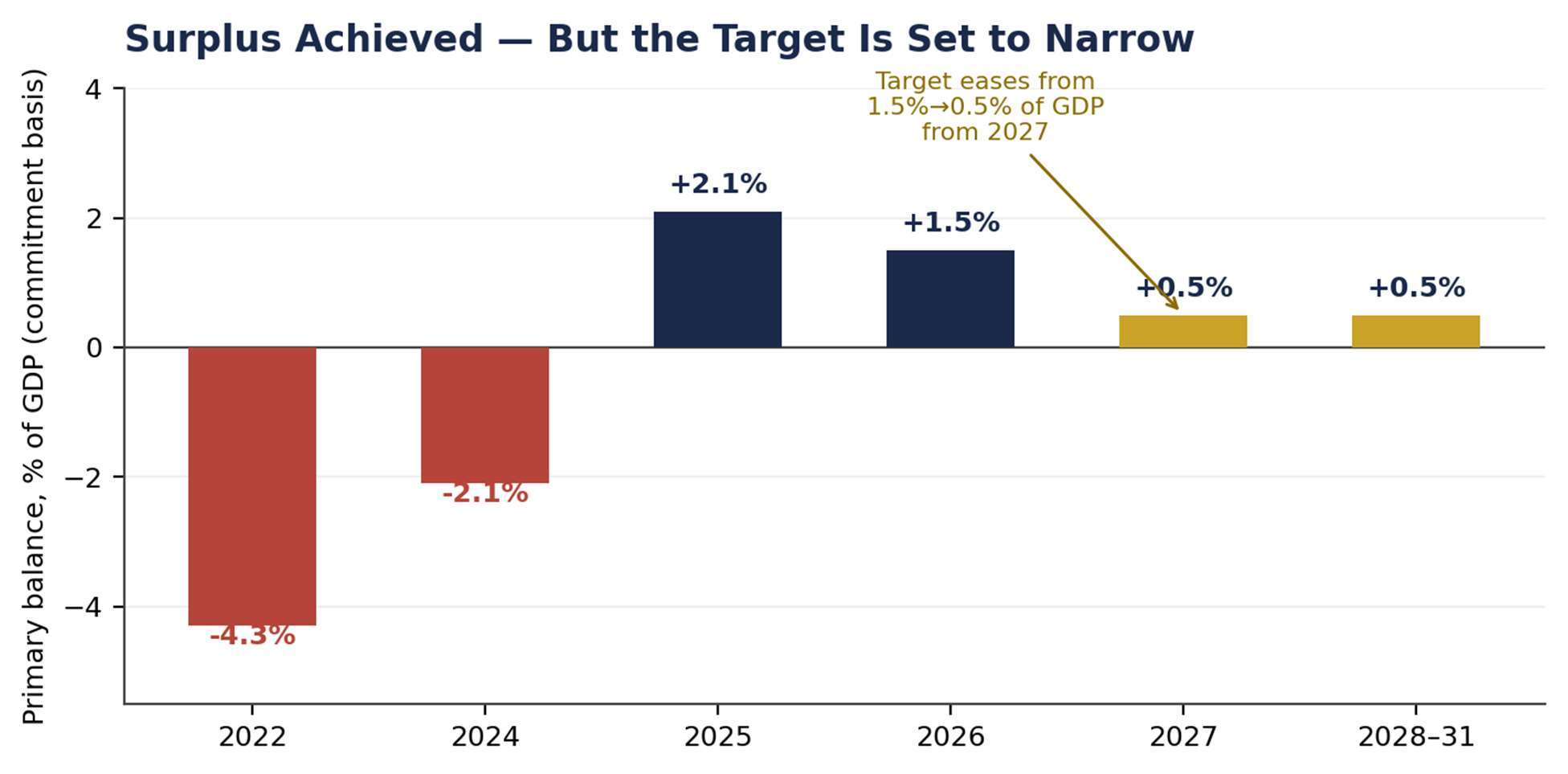
One encouraging feature of the IMF report is that it does not advocate permanent austerity. Instead, it recognises that Ghana's improving debt outlook has created carefully calibrated fiscal space for development spending while maintaining debt sustainability. At the same time, it cautions that recent fiscal adjustment has relied heavily on expenditure compression, a strategy that may prove difficult to sustain given Ghana's significant development and security needs.
That calibration cuts both ways: the primary surplus target is set to narrow from 1.5% of GDP to 0.5% from 2027 onward, and the IMF is explicit that this remains debt-consistent only provided further progress is made on domestic revenue mobilisation, public financial management, and state-owned enterprise oversight - precisely the areas where implementation has historically lagged.
The lesson is clear. The objective should not simply be to spend less, but to spend better. Every cedi borrowed should finance investments that expand Ghana's productive capacity: roads, energy infrastructure, irrigation, digital connectivity, education and healthcare, rather than merely increasing recurrent expenditure. Fiscal sustainability should therefore become synonymous with higher-quality public investment.
Achieving fiscal quality requires stronger institutions that govern public finances. Improving public investment management, strengthening expenditure controls, enhancing fiscal transparency, and fully operationalising independent fiscal oversight will help ensure that scarce public resources are allocated efficiently. Quality public investment also requires rigorous project selection, transparent procurement, and measurable development outcomes rather than politically motivated spending.
Fiscal sustainability must also support long-term growth. Public investment should crowd in rather than crowd out private investment, creating an environment in which businesses can expand, innovate, and generate productive employment. Durable fiscal consolidation cannot rely on expenditure restraint alone. It requires stronger domestic revenue mobilisation through improved tax administration, broader compliance, modernised tax systems, and reforms that ensure Ghana captures a fair share of revenues from its natural resources.
Good fiscal policy is not measured only by the size of the deficit. It is measured by what public spending produces and whether the institutions managing that spending can prevent waste, arrears and hidden liabilities.
Institutions Matter More Than IMF Programmes
Perhaps the greatest lesson from Ghana's recovery is that lasting prosperity ultimately depends on institutions. Macroeconomic stabilisation can be supported by an IMF programme, but sustainable economic transformation must be anchored in strong domestic institutions.
These institutions, not IMF programmes, will determine whether macroeconomic stability survives changes in political leadership.
- Credible fiscal rules
- An independent central bank
- Transparent public financial management
- Effective domestic revenue administration
- Efficient public investment management
- Well-governed state-owned enterprises
The IMF appropriately emphasises strengthening revenue administration, improving public investment management, enhancing oversight of state-owned enterprises, safeguarding central bank independence, and increasing fiscal transparency through regular fiscal strategy documents and comprehensive assessments of fiscal risks. These are permanent institutional reforms, not temporary crisis-management measures.
Institutions are judged not by the quality of legislation alone, but by the consistency and effectiveness with which reforms are implemented. Macroeconomic stability cannot depend solely on IMF programmes. It requires political ownership that survives election cycles, resists reform fatigue, and maintains policy credibility even when difficult decisions become politically costly.
Why Central Bank Credibility Matters
Inflation has fallen dramatically, but maintaining price stability requires more than achieving low inflation today. It requires preserving the credibility of the institutions responsible for delivering low inflation tomorrow.
The IMF stresses that safeguarding monetary credibility depends on protecting the independence of the Bank of Ghana, ending quasi-fiscal activities, completing the transfer of the Domestic Gold Purchase Programme to GoldBod, and recapitalising the central bank. These reforms may appear highly technical. They are not. DGPP-related losses are estimated at 1.5% of GDP, and the recapitalisation memorandum of understanding between the Ministry of Finance and the Bank of Ghana stretches to 2032, reflecting the seriousness of the damage to the balance sheet.
A credible central bank anchors inflation expectations, strengthens investor confidence, reduces borrowing costs, and provides the foundation for sustainable economic growth. Credibility, however, depends on more than statutory independence. It also requires a financially sound central bank capable of conducting monetary policy without the burden of persistent quasi-fiscal losses.
Equally important is ensuring that any remaining quasi-fiscal activities are fully transparent and appropriately reflected within the broader fiscal framework. Monetary credibility is strengthened when fiscal and monetary responsibilities are clearly separated, and institutional mandates are respected.
The Next Phase Must Be Private Sector-Led Growth
Macroeconomic stability alone will not generate the sustained growth Ghana needs. The next phase of Ghana's economic transformation must focus on creating an environment in which businesses can invest with confidence, innovate, expand production, compete internationally, and create productive jobs.
Achieving that objective requires more than prudent macroeconomic management. It demands a stronger business environment, greater competition, continued investment in human capital and infrastructure, improved access to finance, and policies that encourage value addition across agriculture, manufacturing, services and the digital economy.
A resilient and well-functioning financial system will play a central role in this transition. Ghana's banking sector has strengthened but remains uneven: capital buffers have improved and liquidity is ample, yet the IMF flags unresolved governance and risk-management weaknesses at some state-owned and domestic private banks, alongside widespread distress among specialised deposit-taking institutions.
A healthy financial system does more than safeguard deposits. It allocates capital efficiently, supports entrepreneurship, finances business expansion, and enables firms to invest, innovate, and create jobs. Long-term prosperity will depend on higher productivity, greater economic diversification, and a dynamic private sector capable of generating quality employment for Ghana's growing labour force.
Government's role is therefore evolving, from stabilising the economy during a crisis to creating the conditions in which private enterprise becomes the primary engine of sustainable, inclusive, and productivity-driven growth.
Conclusion
Stability is the foundation, not the destination.
The Extended Credit Facility programme has come to a close, but Ghana's reform agenda is entering a new phase. Its successor, the Policy Coordination Instrument, provides no financial support. Instead, it signals to investors, development partners and financial markets that Ghana remains committed to sound macroeconomic management and high-quality structural reforms.
This is a lower-commitment instrument arriving when the IMF report's Risk Assessment Matrix rates geopolitical tension, trade disruption, commodity volatility and fiscal spillovers from global interest rates as high-likelihood, high-impact risks. Ghana is trading a financing backstop for a signalling instrument just as the Fund's own risk matrix is flashing red.
- Can Ghana maintain fiscal discipline without the pressure of IMF financing?
- Can institutions continue to strengthen once the urgency of the crisis has faded?
- Can structural reforms remain politically sustainable after macroeconomic stability has been restored?
Ghana should celebrate its remarkable progress. The country has moved from economic crisis to macroeconomic stability faster than many observers expected. But the next chapter will be written by the strength of its institutions, the quality of its public investment, the governance of its state-owned enterprises, the credibility of its central bank, the resilience of its financial system, and its ability to foster a dynamic private sector that creates productive jobs and raises living standards.
Macroeconomic stability wins time; institutions determine whether that time is transformed into prosperity.
History will judge this period not by how quickly inflation fell, but by whether Ghana used today's stability to build tomorrow's prosperity.